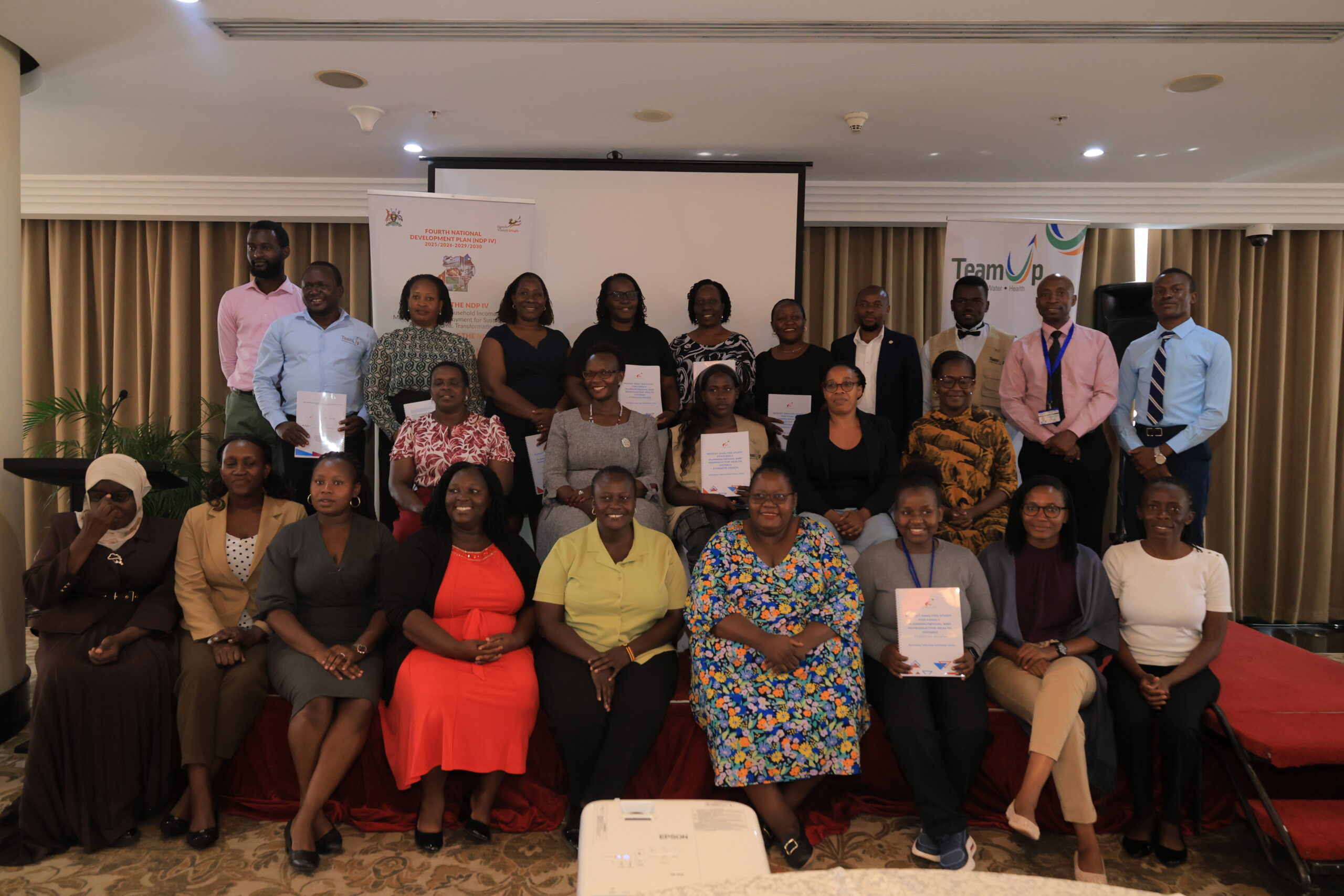
On 26th November 2025, the Family Planning Budget Advocacy Group (FPBAG) convened a landmark meeting at Sheraton Kampala Hotel, co-convened by the National Planning Authority (NPA) and Action 4 Health Uganda (A4HU). The meeting brought together over 40 stakeholders from government agencies, civil society organizations, development partners, and youth-led initiatives. It was significant not only for revitalizing FPBAG’s coordination efforts but also for launching the Family Planning Budget Analysis Study, commissioned by A4HU under the TeamUp Uganda program and presented by Samasha. This study provided critical insights into Uganda’s FP/SRH financing landscape and set the tone for evidence-based advocacy moving forward.
Uganda’s population, now at 45.9 million, remains predominantly youthful, with 73.1% under 30. This demographic structure offers opportunities to harness the demographic dividend, but only if deliberate investments are made in health, education, and employment. The Fourth National Development Plan (NDP IV) prioritizes human capital development and inclusive growth, recognizing family planning as central to reducing fertility rates, improving maternal health, and enabling socio-economic transformation. However, the meeting highlighted a pressing concern: donor support for FP commodities has sharply declined, from UGX 25.8 billion in FY2022/23 to UGX 10.7 billion in FY2024/25, while domestic allocations remain insufficient. Although the Ministry of Health’s allocation to reproductive health commodities increased to UGX 32.5 billion, only UGX 5 billion was earmarked for family planning. Off-budget donor financing still accounts for over 79% of RMNCAH funding, raising concerns about sustainability and transparency.
The study revealed stark gaps at both national and district levels. At the national level, FP programs under Vote 014 received only UGX 39 million in FY2022/23, representing just 1.4% of the reproductive health program budget. At the district level, Kassanda allocated UGX 1.2 million (1.4%) of its reproductive health budget to FP in FY2022/23, while Mityana allocated UGX 2.4 million. Both districts experienced sharp declines in allocations following the conclusion of Results-Based Financing support. These findings mirror global trends, with SRHR funding dropping by 27% in 2023, leading to stockouts, rising unintended pregnancies, and unsafe abortions in low- and middle-income countries.
The meeting featured powerful voices advocating for change. Dr. Hamis Mugendawala, representing the National Planning Authority, emphasized the need to shift from charity-based, free contraceptive services to rights-based, affordable FP services integrated into health insurance and statutory grants. He called for financial resilience and greater government investment in FP. Ms. Sarah Kintu, Chief Executive Officer of Action 4 Health Uganda, expressed her excitement about revitalizing FPBAG and reaffirmed A4HU’s commitment to empowering young people to access sexual and reproductive health services. She emphasized that the meeting’s objectives were to reactivate FPBAG engagements, chart a common agenda for family planning amid dwindling donor funding, share findings from the Mityana and Kassanda study on FP financing, and align interventions with the priorities of NDP IV. “Discussions will be grounded in the realities of declining donor support, implementation gaps in the FP-CIP, and the urgent need to mobilize domestic resources,” she said, adding that stakeholders, including government ministries, development partners, CSOs, and youth-led organizations, must engage in strategic conversations to shape the future of FP financing and programming in Uganda.
The Youth Champions also took centre stage, presenting bold advocacy asks to stakeholders. They called for mandating FP/SRH budgeting at local government level and strengthening youth participation in planning and budgeting processes at sub-national level. These demands reflect the TeamUp Uganda program’s core mission: equipping young advocates with data-driven insights to influence political decision-making and ensure FP priorities mirror community realities.
Participants agreed on several critical resolutions to advance FP financing and advocacy. FPBAG will hold regular quarterly meetings, with a blend of physical and virtual engagements for sustainability. Stakeholders committed to advocating for the creation of clear FP budget lines in district budgets to improve visibility and accountability. There was renewed commitment to push for the passage of the National Health Insurance Bill as a mechanism to enhance FP financing. The meeting also resolved to strengthen advocacy capacity for new Members of Parliament and district planners to champion FP and SRHR issues. A centralized FP data platform will be established to enhance monitoring, evaluation, and evidence-based advocacy. Finally, FPBAG’s leadership and communication platform will be rejuvenated, with representatives from Samasha, A4HU, Plan International, Pathfinder International, and NPA taking coordination roles.
As Uganda moves forward with the implementation of the Fourth National Development Plan (NDP IV) and transitions to the third phase of the Family Planning Costed Implementation Plan (FP-CIP III), the FPBAG meeting serves as a strategic rallying point for action. NDP IV is already shaping Uganda’s development agenda with a strong focus on human capital development, inclusive growth, and socio-economic transformation. Family planning is central to these priorities because it directly influences fertility trends, maternal health, and the ability of households to invest in education and economic opportunities. FP-CIP III will build on lessons from previous phases to scale up access to FP services, integrate FP into multi-sectoral programs, and strengthen accountability at national and sub-national levels.
The Family Planning Budget Study is a critical tool for advocacy, providing stakeholders with the evidence needed to influence policy, secure domestic financing, and hold decision-makers accountable. It equips advocates with data to demonstrate gaps, track commitments, and push for integration of FP into broader development frameworks. By anchoring advocacy in hard facts, the study ensures that conversations move beyond rhetoric to actionable solutions that reflect community realities.
Ultimately, the FPBAG meeting is a clarion call for political will, financial commitment, and community-driven action. It signals a future where family planning is integrated into Uganda’s development priorities, supported by robust accountability systems, and championed by empowered young advocates determined to create a Uganda where every individual can make informed choices about their reproductive health.